
Why You're Really Fighting About Nothing
It starts with a cabinet door left open. Or a text that wasn't returned fast enough. Or the wrong tone used while asking a perfectly reasonable question about dinner.
Twenty minutes later, you're both in separate rooms, hearts pounding, wondering how a cabinet door turned into a referendum on the entire relationship. You replay the argument and can't even pinpoint the moment it went sideways. You just know you're hurt, they're hurt, and neither of you feels heard.
If this sounds familiar, you're not alone — and you're not broken. Research consistently shows that most couple fights aren't actually about the surface topic. A landmark study by John Gottman's lab found that 69% of relationship conflicts are perpetual, meaning they recur because they're rooted in fundamental differences in personality, values, or emotional needs — not in who forgot to buy milk. The real fight is almost always happening underneath.
This article unpacks what's really going on when you find yourselves fighting about nothing, why small issues escalate so quickly, and what you can do — starting today — to interrupt the pattern.
Key Takeaways
- Most trivial arguments are proxies for deeper unmet emotional needs like feeling respected, valued, or secure in the relationship.
- Your nervous system can't tell the difference between a genuine threat and a perceived one — which is why a comment about dishes can trigger a fight-or-flight response.
- Identifying your core emotional trigger (not your partner's behavior) is the single most effective way to de-escalate recurring fights.
- A simple "what am I really feeling?" pause before responding can prevent 80% of unnecessary escalations.
- Written agreements about recurring friction points reduce ambiguity and give both partners something to reference instead of relitigating the same issues.
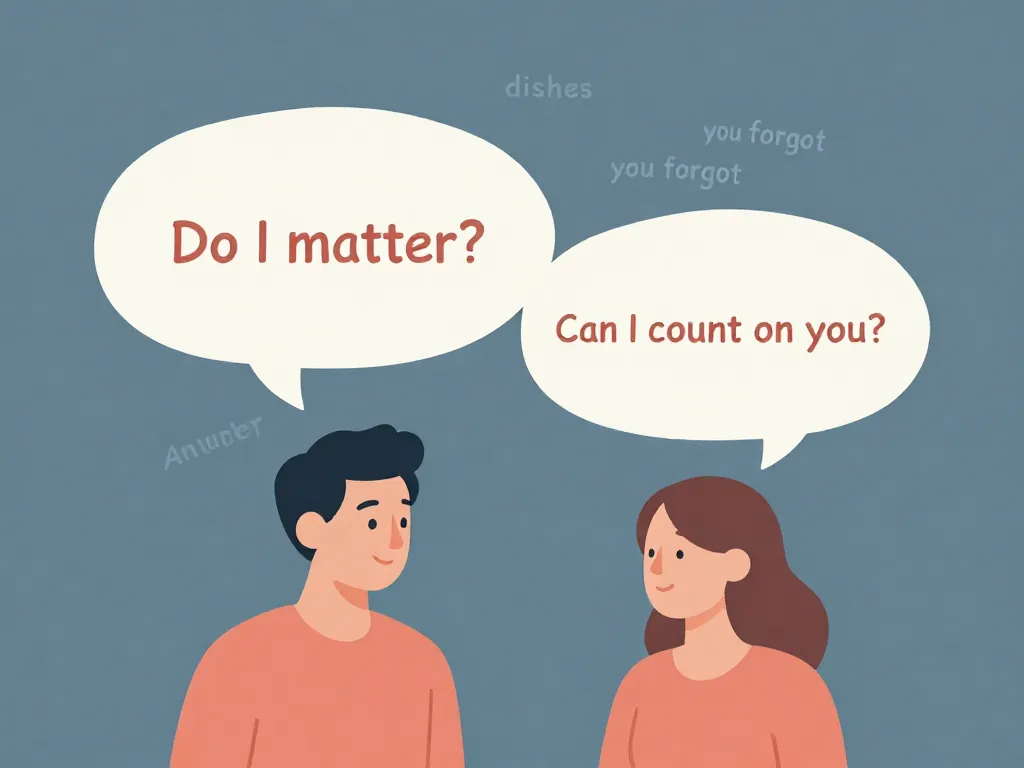
The Anatomy of a Fight About "Nothing"
Let's look at what actually happens during one of these fights.
The surface event: Sarah asks Marco if he remembered to call the electrician. He says he forgot. She sighs. He says, "It's not a big deal." She says, "It never is." He says, "What's that supposed to mean?" And now they're off.
On the surface, this is about an electrician. But here's what's happening underneath:
- Sarah's inner narrative: I asked him to do one thing. He forgot again. I feel like I'm managing this household alone. Does he even care about what matters to me?
- Marco's inner narrative: She's keeping score again. I can never do enough. One mistake and I'm a failure in her eyes. Why does she always assume the worst?
Neither of them is wrong. Both of them are responding to real emotional pain. But neither of them is talking about the actual pain — they're arguing about an electrician.
This is the anatomy of fighting about nothing: a surface trigger activates a deeper emotional wound, and both partners respond to the wound while arguing about the trigger.
Why Small Issues Escalate So Quickly
If you've ever been baffled by how fast a minor issue becomes a full-blown argument, there's a neurological explanation.
Your Brain Doesn't Distinguish Between Types of Threat
When you feel dismissed, unseen, or unimportant — even in a small moment — your amygdala (the brain's threat detection center) activates the same stress response it would if you were in physical danger. Your heart rate spikes, your muscles tense, and your prefrontal cortex (the part responsible for rational thought and perspective-taking) goes partially offline.
This is why you say things in arguments that you'd never say calmly. It's not a character flaw. It's biology.
The "Stack" Effect
Small, unaddressed frustrations accumulate. Each one alone is manageable. But they stack. The cabinet door isn't just a cabinet door — it's the cabinet door on top of the unreturned text on top of last Tuesday's dismissive comment on top of the feeling that your needs consistently rank second.
By the time the stack topples, the reaction looks disproportionate to the trigger. And it is — because the reaction isn't to the trigger. It's to the stack.
Confirmation Bias in Conflict
Once you've developed a narrative about your partner ("they don't listen," "they're always critical"), your brain will selectively notice evidence that confirms that story and filter out evidence that contradicts it. A forgotten phone call becomes proof of a pattern rather than an isolated mistake.
This doesn't make you unfair. It makes you human. But recognizing it gives you the power to question the narrative before reacting to it.

The 5 Hidden Triggers Behind Most "Nothing" Fights
After reviewing decades of relationship research — from Gottman's Sound Relationship House theory to Sue Johnson's Emotionally Focused Therapy model — five core emotional triggers emerge beneath most trivial arguments.
1. "Do I Matter to You?"
This is the most common hidden trigger. When a partner forgets a request, checks their phone during a conversation, or seems disengaged, the underlying question isn't "why didn't you do this?" — it's "am I important to you?"
Shows up as: Arguments about chores, forgotten tasks, punctuality, or perceived inattentiveness.
2. "Do You Respect Me?"
This trigger fires when someone feels talked down to, overridden in decisions, or treated like their opinions don't carry weight. It's especially common when couples have different approaches to finances, parenting, or household management.
Shows up as: Arguments about tone, how decisions were made without consulting the other, or comments that feel condescending.
3. "Can I Count on You?"
This is about reliability and trust — not in the dramatic, infidelity sense, but in the everyday sense. Will you follow through? Will you show up? Can I depend on you when things get hard?
Shows up as: Arguments about broken promises, inconsistency, or one partner feeling like they carry a disproportionate load.
4. "Am I Enough?"
This trigger is about adequacy and acceptance. When one partner's behavior signals (intentionally or not) that the other isn't meeting some standard, it can activate deep insecurity.
Shows up as: Arguments about comparisons (to friends, exes, or family members), criticism of habits or personality traits, or feeling like you're always falling short.
5. "Are We Okay?"
This is the existential trigger — the fear that the relationship itself is in jeopardy. When conflict arises, some people don't just feel upset about the issue; they feel terrified that the relationship might not survive.
Shows up as: Catastrophizing during arguments ("maybe we're just not compatible"), withdrawal, or desperate attempts to "fix" the fight immediately rather than sitting with discomfort.
How to Stop Fighting About Nothing: A Practical Framework
Understanding the triggers is half the work. Here's how to apply that understanding in real time.
Step 1: Pause and Name the Real Feeling
Before responding in a heated moment, ask yourself one question: "What am I actually feeling right now?"
Not "what did they do?" — that keeps you focused on the surface. Instead, try to identify the emotion underneath the irritation:
- Hurt
- Dismissed
- Unappreciated
- Anxious
- Lonely
This isn't about suppressing your reaction. It's about making sure you respond to the right thing.
Try this language: Instead of "You never help around here," try "I'm feeling overwhelmed and like I'm carrying this alone, and that makes me feel unimportant to you."
The difference is enormous. The first invites defensiveness. The second invites connection.
Step 2: Get Curious About Your Partner's Trigger
When your partner reacts in a way that seems disproportionate, resist the urge to say "you're overreacting." Instead, get curious.
Ask (genuinely, not sarcastically): "It seems like this hit a nerve. Can you help me understand what's going on for you?"
This single question has the power to completely redirect a conversation from combat to collaboration.
Step 3: Map Your Recurring Fights
Sit down together — outside of conflict, when you're both calm — and identify your top three recurring arguments. For each one, try to answer:
- What's the usual surface trigger?
- What does each person feel underneath?
- What does each person need in that moment?
Writing this down is more powerful than just discussing it. The act of documenting it creates a shared reference point that reduces the "he said / she said" dynamic. Tools like Servanda can help couples formalize these kinds of agreements — clarifying expectations, documenting what you've discussed, and giving you something concrete to revisit when tensions rise again.
Step 4: Create a De-Escalation Protocol
Agree on a plan for when things start heating up. This should be specific, not vague. For example:
- A code word or phrase that either partner can use to signal "I need a pause" without it feeling like shutdown or abandonment. Something neutral like "I need 15" works better than "I can't talk to you right now."
- A defined cool-down period — 20 minutes is a research-backed minimum for the nervous system to recalibrate after activation.
- A commitment to return. The pause only works if both partners trust that the conversation will continue. Agree to come back within a set timeframe.
Step 5: Address the Stack Before It Topples
Don't wait for things to accumulate. Build a regular habit of checking in — weekly or biweekly — where you can surface small frustrations before they calcify into resentment.
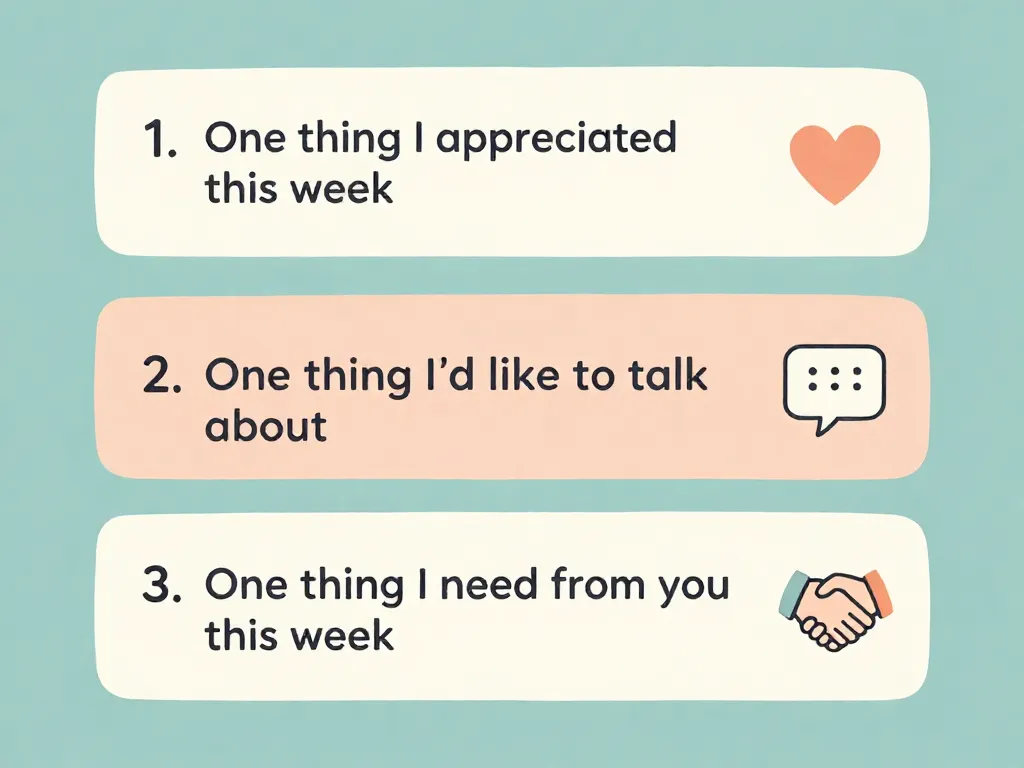
A simple format:
- One thing I appreciated this week: (Start with genuine positivity — not as a tactic, but because it sets the nervous system at ease.)
- One thing I'd like to talk about: (Raise one small concern before it becomes a big one.)
- One thing I need from you this week: (Make a specific, actionable request.)
This isn't therapy. It's maintenance. And it takes fifteen minutes.
What If We've Already Established a Bad Pattern?
First: grace. Most couples fall into these patterns because no one taught them differently. You're not failing at your relationship — you're learning in the middle of it, which is harder.
Second: patterns can be rewritten, but it takes deliberate effort from both partners. Here are signs it might be time to bring in outside support:
- The same fight happens more than once a month with no resolution.
- One or both partners regularly shut down or stonewall during conflict.
- Arguments frequently escalate to yelling, name-calling, or contemptuous language.
- You've started avoiding topics entirely because you know they'll lead to a fight.
- You feel more like adversaries than partners.
A skilled couples therapist or structured conflict resolution process can help you identify the underlying patterns and build new ones. The goal isn't to eliminate conflict — that's neither possible nor healthy. The goal is to fight about the real thing, not the proxy.
FAQ
Is it normal for couples to fight about trivial things?
Yes, extremely normal. Research shows the majority of couple arguments center on everyday issues like housework, money, and scheduling — not dramatic betrayals. What matters isn't whether you argue about small things, but whether you can recognize the emotional needs beneath them and address those directly.
How do I stop getting triggered by small things my partner does?
You probably won't stop getting triggered entirely — and that's okay. The goal is to increase the gap between the trigger and your response. Practicing the "what am I actually feeling?" pause helps you respond to the real emotion rather than reacting to the surface event. Over time, this rewires the pattern.
What if my partner doesn't think our fights are a problem?
This is common and can feel isolating. Try framing it not as "we have a problem" but as "I want us to feel closer, and I think there's a pattern we could improve." Focus on your own experience rather than diagnosing theirs. If they remain resistant, working with a therapist individually can still help you shift your side of the dynamic, which often creates change in the relationship overall.
How do I bring up recurring issues without starting another fight?
Timing and framing matter enormously. Choose a calm, neutral moment — not right after a conflict. Use "I" statements that describe your experience rather than "you" statements that assign blame. And be specific about what you need going forward rather than cataloging past offenses.
Can fighting actually be healthy for a relationship?
Conflict itself isn't harmful — contempt, stonewalling, and unresolved resentment are. When couples can disagree while maintaining respect and genuine curiosity about each other's perspective, conflict becomes a vehicle for deeper understanding. The healthiest couples aren't the ones who never fight; they're the ones who repair quickly and learn from each disagreement.
Moving Forward
The next time you find yourself in a heated argument over something that, logically, shouldn't be this big of a deal — pause. Not to suppress what you're feeling, but to ask what you're actually feeling.
Chances are, you're not fighting about the dishes, the thermostat, or the text that came three hours late. You're fighting about whether you matter, whether you're respected, whether you can rely on each other.
Those are fights worth having — but only if you're having them honestly.
The pattern doesn't change overnight. But it changes the moment one of you decides to look beneath the surface and say, "I think what I'm really trying to say is..." That's not weakness. That's the bravest thing you can do in a relationship.
Start there. Start tonight.